
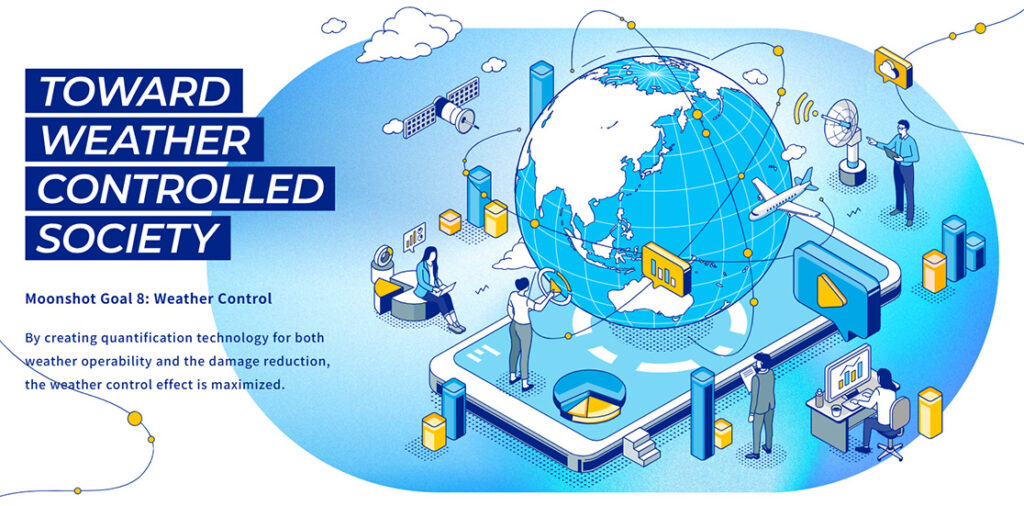
Significance of the Research
- In recent years, intense rainfall disasters caused by water vapor flux from the ocean have become increasingly frequent, resulting in severe damage in terrestrial areas. To mitigate these impacts, our team is developing a technology that induces heavy rainfall over the ocean by forming clusters of cumulonimbus clouds upstream, thereby significantly reducing atmospheric water vapor before it reaches land. Although direct human intervention in weather modification has its limitations, we aim to develop a feasible approach by leveraging the self-organization process in which one cumulonimbus cloud generates another. To implement this technology in society, we are also advancing social science research on legal frameworks and environmental risk assessments. Our goal is to establish socially acceptable weather control technologies by 2050.
- We have already initiated weather modification and cloud seeding experiments, and are developing a digital twin that integrates various remote sensing datasets. Through these efforts, we continue to work toward the realization of weather control technologies.
- This research is being conducted as part of Goal 8 of the Moonshot Research & Development Program, a large-scale initiative led by Japan’s Cabinet Office. Professor Kotsuki serves as the Project Manager for this initiative.
For more details, please visit: https://beyond-predictions.com/en/.
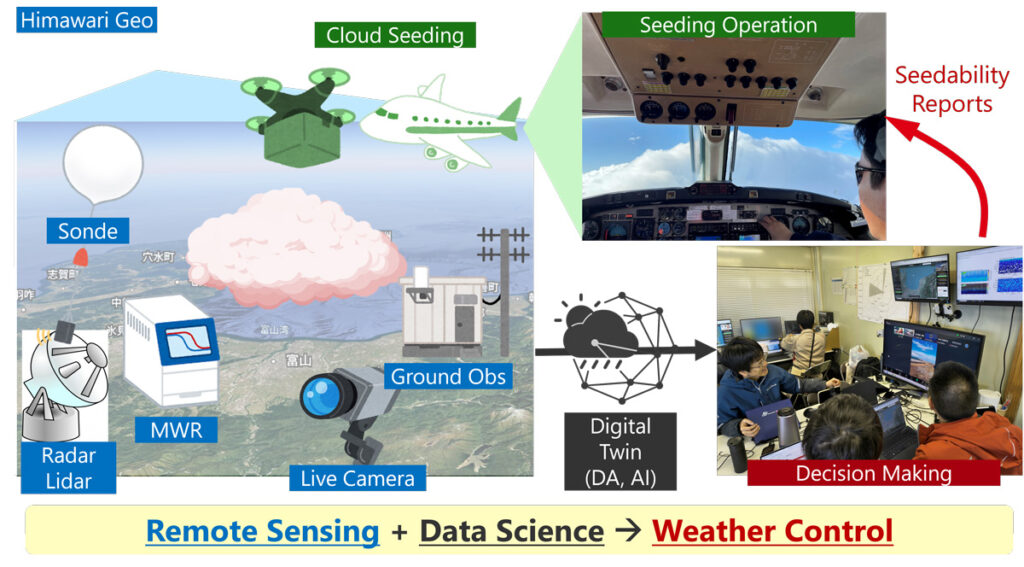
Weather Control Digital Twin Developed in the Moonshot Goal 8 Program
Selected Publications
- Hiraga, Y., Mbugua, J., Kotsuki, S., Suzuki, Y., Chen, S.-H., Hamada, A., Yasunaga, K. and Funatomi, T. (2026): Numerical experiments of cloud seeding for mitigating localization of heavy rainfall: a case study of Mesoscale Convective System in Japan. Nat. Hazards Earth Sys. Sci., 26, 1287-1303. doi: 10.5194/nhess-26-1287-2026 (Mar. 11, 2026) [Link to Press Release in Japanese]
- Kurosawa, K., Okazaki, A., Kawasaki, F. and Kotsuki, S. (2025): Ensemble-based model predictive control using data assimilation techniques. Nonlin. Processes Geophys., 32, 293-307. doi: 10.5194/npg-32-293-2025
- Kawasaki, F. and Kotsuki, S.(2024): Leading the Lorenz-63 system toward the prescribed regime by model predictive control coupled with data assimilation. Nonlin. Processes Geophys. , 31, 319-333. doi: 10.5194/npg-31-319-2024
(last update: 2026/03/22)